
Storm Windows for Soundproofing
Simple storm windows with as thick glass as possible will help with soundproofing. Expect about a 35% noise reduction if they seal tightly and the air space between the windows is at least 2". Be careful here. They are not designed to stop noise and usually stop noise more by accident that on purpose.
Using this same idea, if you buy a regular window and install it as a second window, it might work as well as a storm window. There can be several problems with this as a soundproofing solution, however. A good seal is very important in stopping noise, and storm windows are notoriously leaky. Also, the air space that can be created between the two windows is limited. The more air space the better in any soundproofing scenario and storm windows often allow only about an inch or even less. You need over two inches of air space to achieve a very good noise reduction effect, regardless of the window solution chosen.
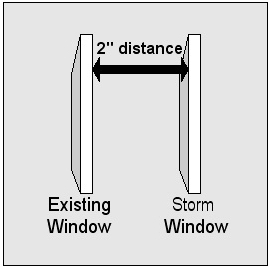
Make sure there is at least 2" of air space between the existing window and the storm window.
Glass thickness in storm windows can also be a problem. A few use 3/16" thick glass, which is good; those with only 1/8" is not that effective. Very few use 1/4" glass or laminated glass.
Soundproofing & Acrylic Windows
Magnetically attached acrylic windows are not recommended for soundproofing. If you are very lucky they can stop noise as much as the storm windows mentioned above. These windows are not easy to operate once installed (technically possible to remove, but not as a practical matter), and are moderate to high priced. The only companies which give STC ratings that we are aware of have lied about these results by not telling you that the air space between the windows tested was 6", with a few other facts that were greatly exaggerated.
Acrylic windows are not effective because of the basic requirement of mass (refer to the Soundproofing Principles covered in our introductory Soundproofing course). Acrylic and other plastics do not have mass. Even at 1" thick, they are not that good at stopping noise. If someone is selling you anything plastic that they claim is designed to stop noise they are wrong.
It may be designed. But it is not designed to stop noise. The sales people are just taking a different product and trying to sell it as a noise reducer. No one we know of sells a good plastic product that does a decent job of stopping noise. We must add “that we know of”: while it is theoretically possible to make a really thick product that will stop a fair amount of noise, the prices would be absurd and the results still limited.
Continue to Window Noise Solution, Part 2